Runtime View
The v4 runtime is significantly simpler than v3: no Gradle daemon, no build graph, no dependency resolution. Tasks are individual script invocations.
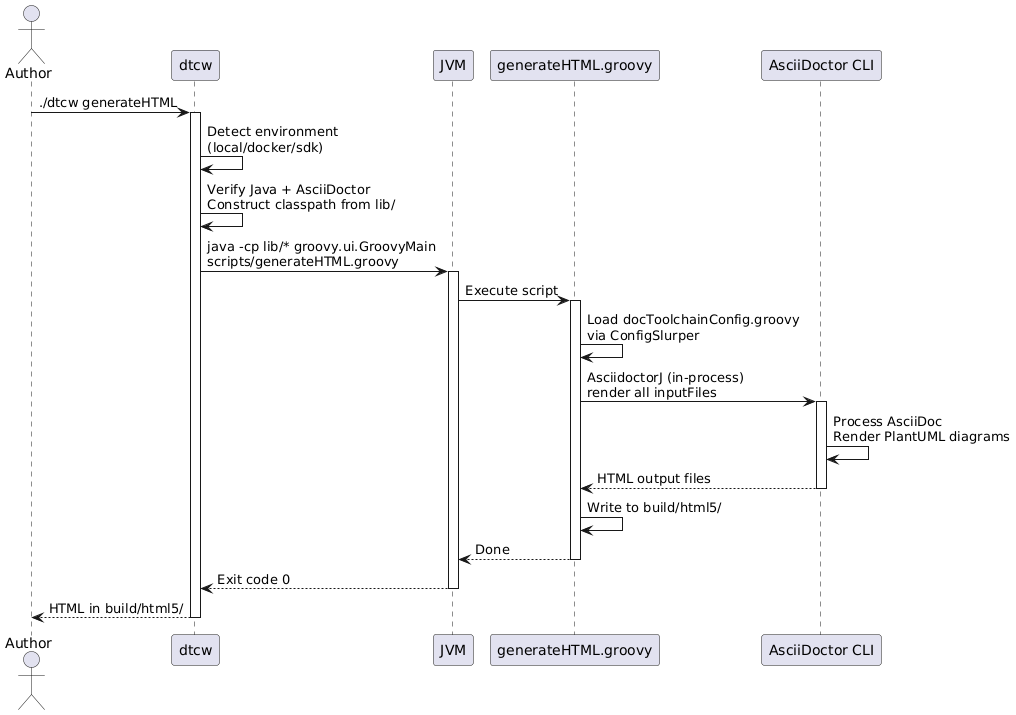
Scenario 1: Generate HTML Documentation
Key differences from v3: No Gradle overhead and no Gradle daemon. AsciiDoctor runs embedded as AsciidoctorJ in the same JVM (ADR-6, revised — the external-CLI option was evaluated but not adopted), so JRuby still initialises in-process on the first render. The Groovy script invokes AsciidoctorJ directly for all inputFiles. Startup is JVM cold start plus JRuby/AsciidoctorJ initialisation (~1-2s combined).
Scenario 2: Publish to Confluence
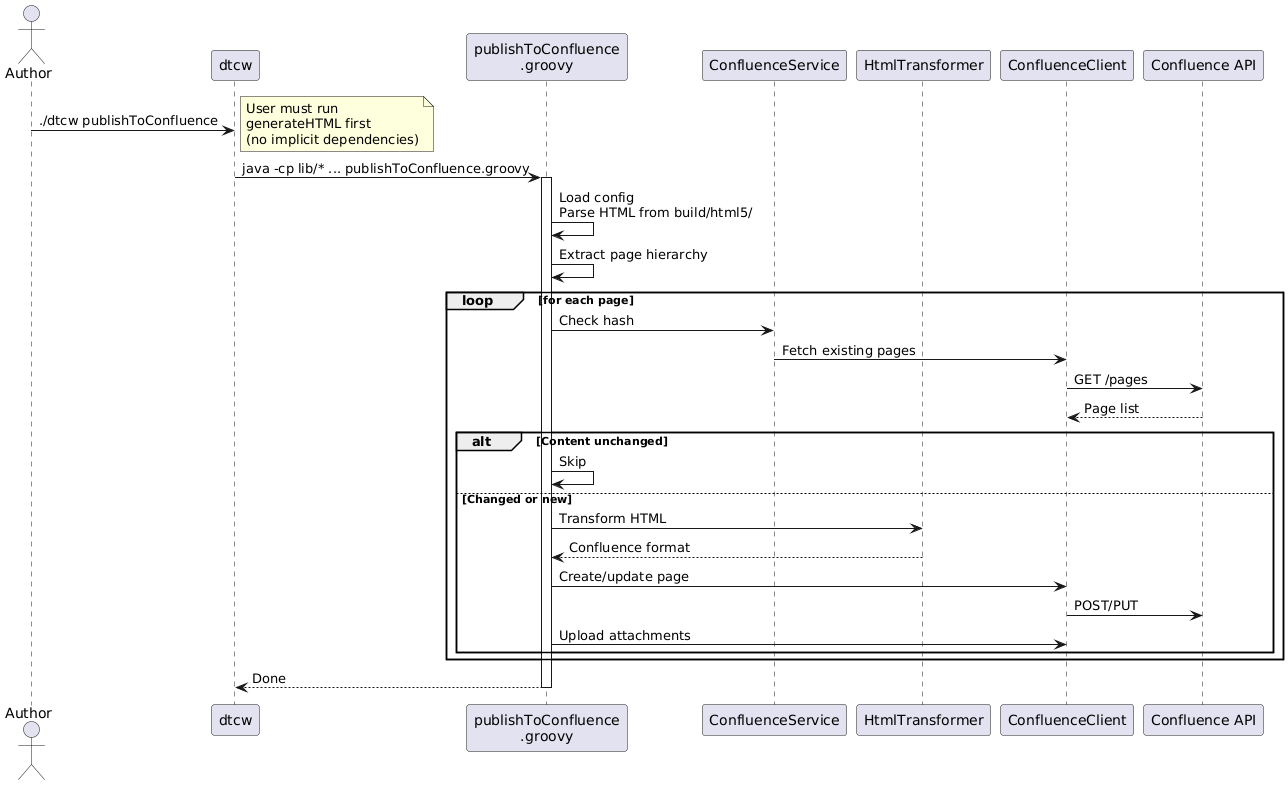
Key difference from v3: The user runs generateHTML and publishToConfluence as separate, explicit commands. There are no implicit task dependencies — each script is self-contained. This matches real-world usage: users rarely chain tasks automatically.
Scenario 3: LLM Modifies Documentation via daCLI
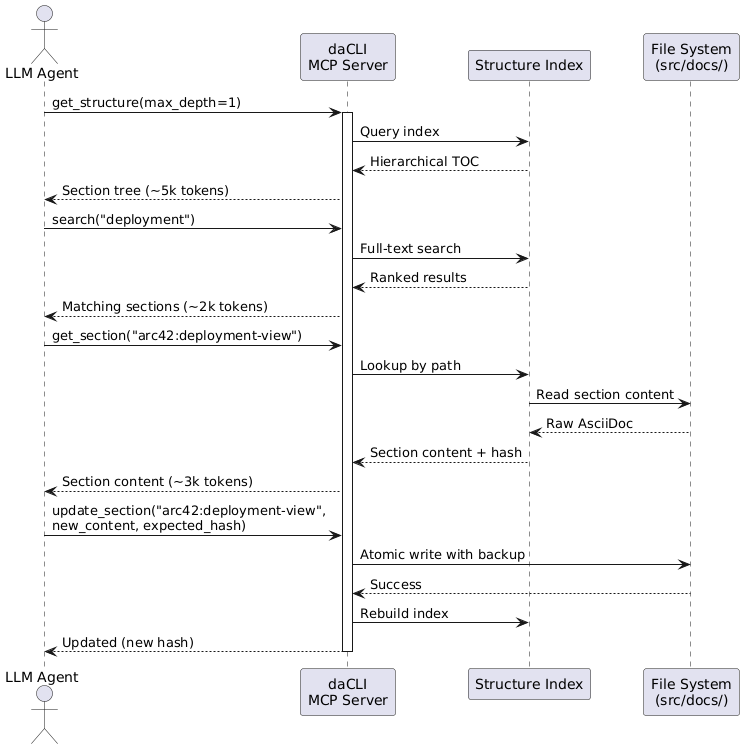
This is a new v4 scenario. The LLM navigates a 50-page documentation project using ~10k tokens instead of the ~100k tokens needed to read all files. daCLI maintains an in-memory index for O(1) lookups. Optimistic locking (hash comparison) prevents concurrent modification conflicts.
Scenario 4: Generate Microsite
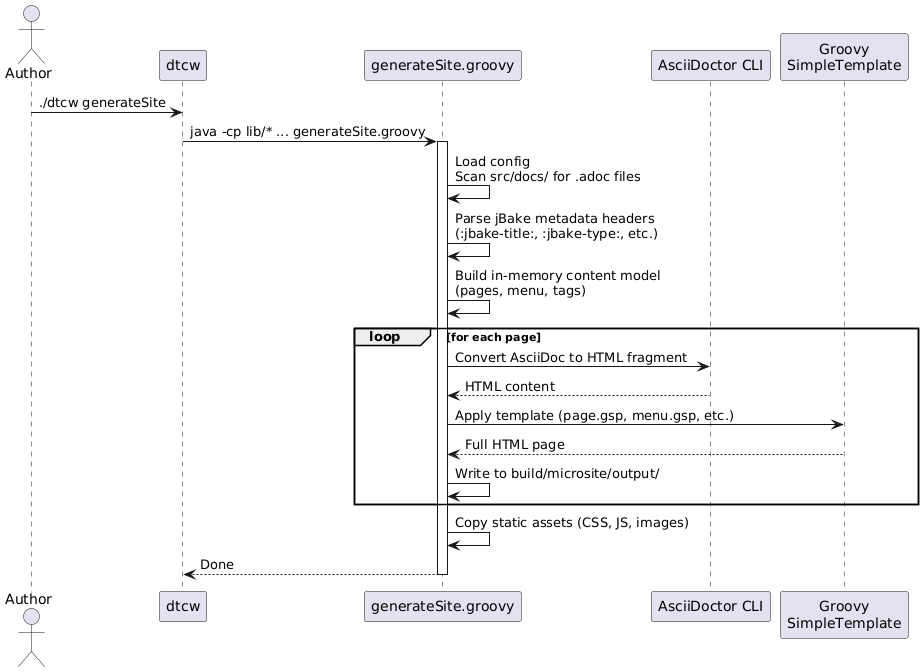
Key difference from v3: No jBake library, no OrientDB content database. The site generator is a Groovy script that reads files, builds an in-memory model, applies Groovy SimpleTemplate templates, and writes static HTML. Runs on all platforms including Apple Silicon (QS-10).
Scenario 5: Error and Recovery — Publish Fails with HTTP 401 / Locked File
This scenario exercises the error-handling path, not the happy path. It shows how the DtcException hierarchy (ADR-8, Chapter 8.5 Error Handling) turns a failure into an actionable message and a differentiated exit code (QS-17).
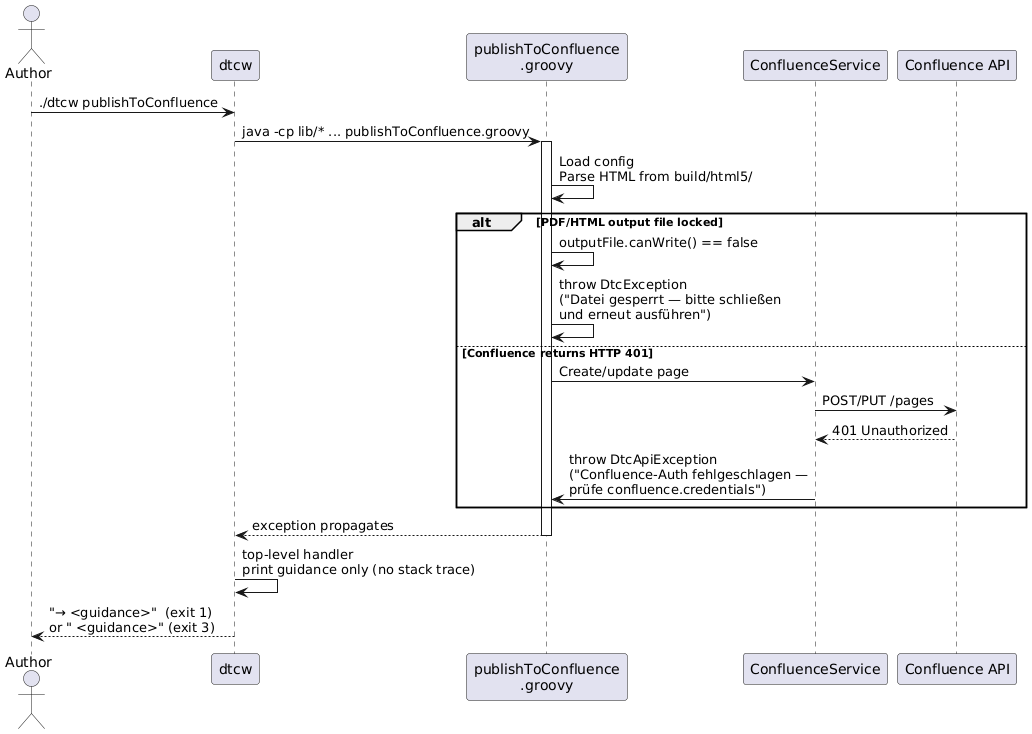
Recovery behaviour: A locked output file raises a DtcException (exit code 1); an HTTP 401 raises a DtcApiException (exit code 3). In both cases the top-level handler prints only the guidance message — what the user must do (close the file, fix the credentials) — and suppresses the stack trace. CI/CD distinguishes a config/credential problem (exit 3) from a user-fixable local issue (exit 1) without parsing logs. This realises quality goal #4 (Actionable error guidance, QS-17) and the Chapter 8.5 Error Handling concept; the exception hierarchy and exit-code table are defined in ADR-8.
Feedback
Was this page helpful?
Glad to hear it! Please tell us how we can improve.
Sorry to hear that. Please tell us how we can improve.