Deployment View
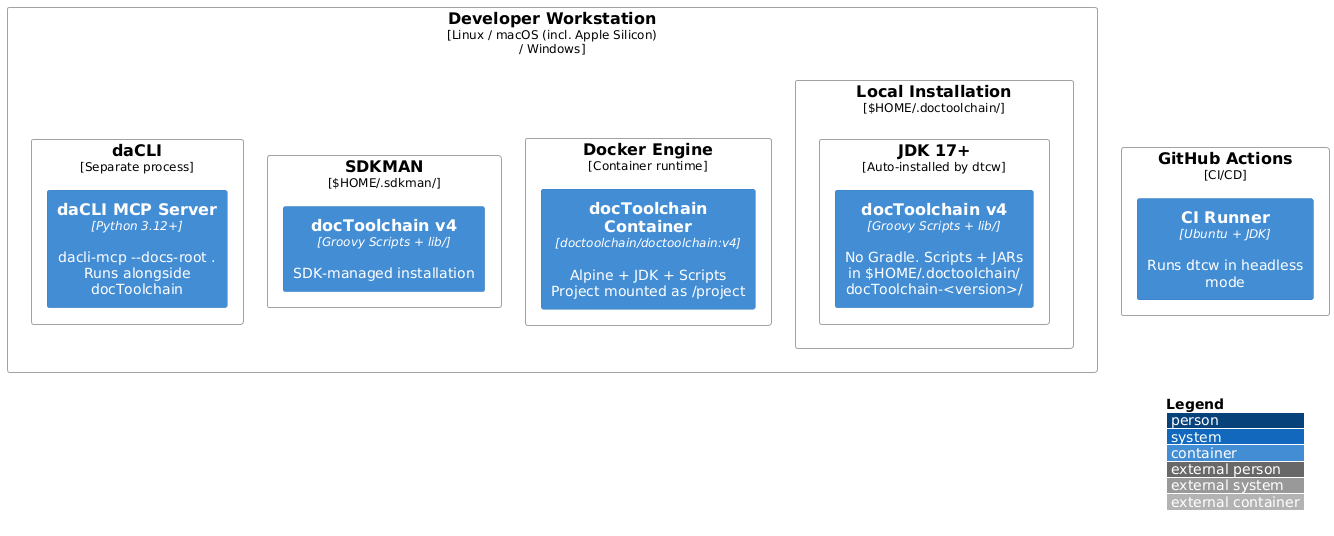
docToolchain v4 supports three execution environments (unchanged from v3). The key difference: without Gradle, the installation footprint is smaller and startup is faster.
Infrastructure Level 1: Execution Environments
- Motivation
-
Three environments remain equally supported (QS-2). Local is fastest (no container overhead). Docker guarantees reproducibility. SDKMAN integrates with JVM ecosystem tooling. daCLI runs as a separate process alongside any environment.
| Environment | v4 changes from v3 | Advantages | Typical Use |
|---|---|---|---|
Local |
No Gradle wrapper download (saves ~95s first run). No daemon. Smaller installation (no Gradle distribution). |
Fastest startup (under 3s). Direct filesystem access. |
Daily development, documentation preview |
Docker |
Smaller image (no Gradle). Faster container startup. |
Consistent environment. No local dependencies beyond Docker. |
CI/CD pipelines, team standardization |
SDKMAN |
Unchanged. |
Familiar JVM tooling. Version switching. |
JVM developers, multi-version testing |
daCLI (companion) |
New in v4. Not bundled — runs as a separate process. |
LLM document access. Runs alongside any docToolchain environment. |
LLM-assisted documentation workflows |
Infrastructure Level 2: CI/CD Pipeline
The CI/CD pipeline simplifies with Gradle removed:
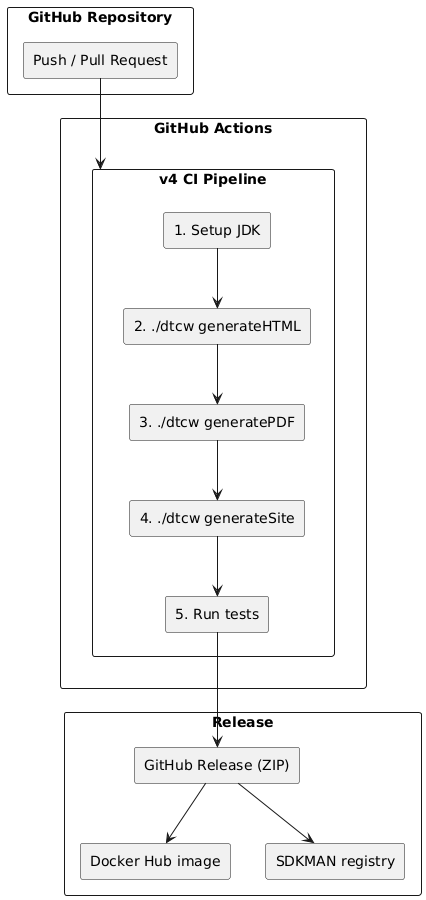
Key simplification: No Gradle cache setup, no ./gradlew clean, no dependency resolution step. Each ./dtcw command is a direct script invocation with predictable timing.
Feedback
Was this page helpful?
Glad to hear it! Please tell us how we can improve.
Sorry to hear that. Please tell us how we can improve.